
Your research idea, written up as a paper whose citations are all real.
ResearchBerry finds published papers on your topic, writes around them in IEEE, APA, Harvard, Vancouver, MLA and more, and hands you the PDF, Word and LaTeX files. See your title and a real page of your format free before you pay.
Sign in with Google. No card. Two free previews. Full papers from ₹699.
By signing in you accept the Terms and Privacy policy.
Benchmarking Convolutional Neural Networks and Vision Transformers for In-Field Crop Disease Diagnosis on Resource-Constrained Mobile Devices
Sample draft · IEEE format
I. Introduction
In smallholder-dominated agricultural economies such as India, timely and precise pathological identification remains paramount . More recently, the computer vision paradigm has expanded toward self-attention mechanisms and vision transformers (ViTs) , . Transformers eliminate the rigid local inductive biases of convolutions, modeling long-range spatial dependencies across fragmented image patches , .
A reference list is only worth something if the papers exist.
General chatbots can write a reference that looks perfect and leads nowhere. Reviewers and examiners check. Here every reference is a record pulled from Crossref, OpenAlex or Europe PMC, and you choose which ones go in.
Made up by a chatbot
Illustration: these three references were invented for this example.
R. Kumar and S. Patel, "Transformer-based leaf disease detection in Indian farms," Journal of Agricultural AI, vol. 14, no. 3, pp. 211–229, 2022.
No DOI. No such paper.
A. Sharma et al., "Edge deployment of vision models for smallholder agriculture," IEEE Transactions on Rural Computing, 2023.
No DOI. No such paper.
M. Rao, "Lightweight CNNs for field photographs," Indian Journal of Plant Informatics, 2021.
No DOI. No such paper.
From ResearchBerry
Taken from the sample paper below. Click any DOI to check it yourself.
G. Li, Y. Wang, Q. Zhao, P. Yuan and B. Chang, “PMVT: a lightweight vision transformer for plant disease identification on mobile devices,” Frontiers in Plant Science, 2023.
doi.org/10.3389/fpls.2023.1256773Z. Chen, G. Wang, T. Lv and X. Zhang, “Using a Hybrid Convolutional Neural Network with a Transformer Model for Tomato Leaf Disease Detection,” Agronomy, 2024.
doi.org/10.3390/agronomy14040673V. S. Mandlik and L. V. Birgale, “A Convolutional Neural Network (CNN) Based Classification Framework for Multi-Crop Disease Detection using Leaf Images,” Current Agriculture Research Journal, 2026.
doi.org/10.12944/carj.13.3.15
A real paper, made in 93 seconds.
The idea was one sentence: “Comparing CNNs and vision transformers for detecting crop leaf diseases from smartphone photos taken in the field, on low-cost phones used by farmers in India.” This is what came back, untouched: 8 pages in IEEE format, 4,860 words, 5 diagrams drawn for the topic and 25 references.
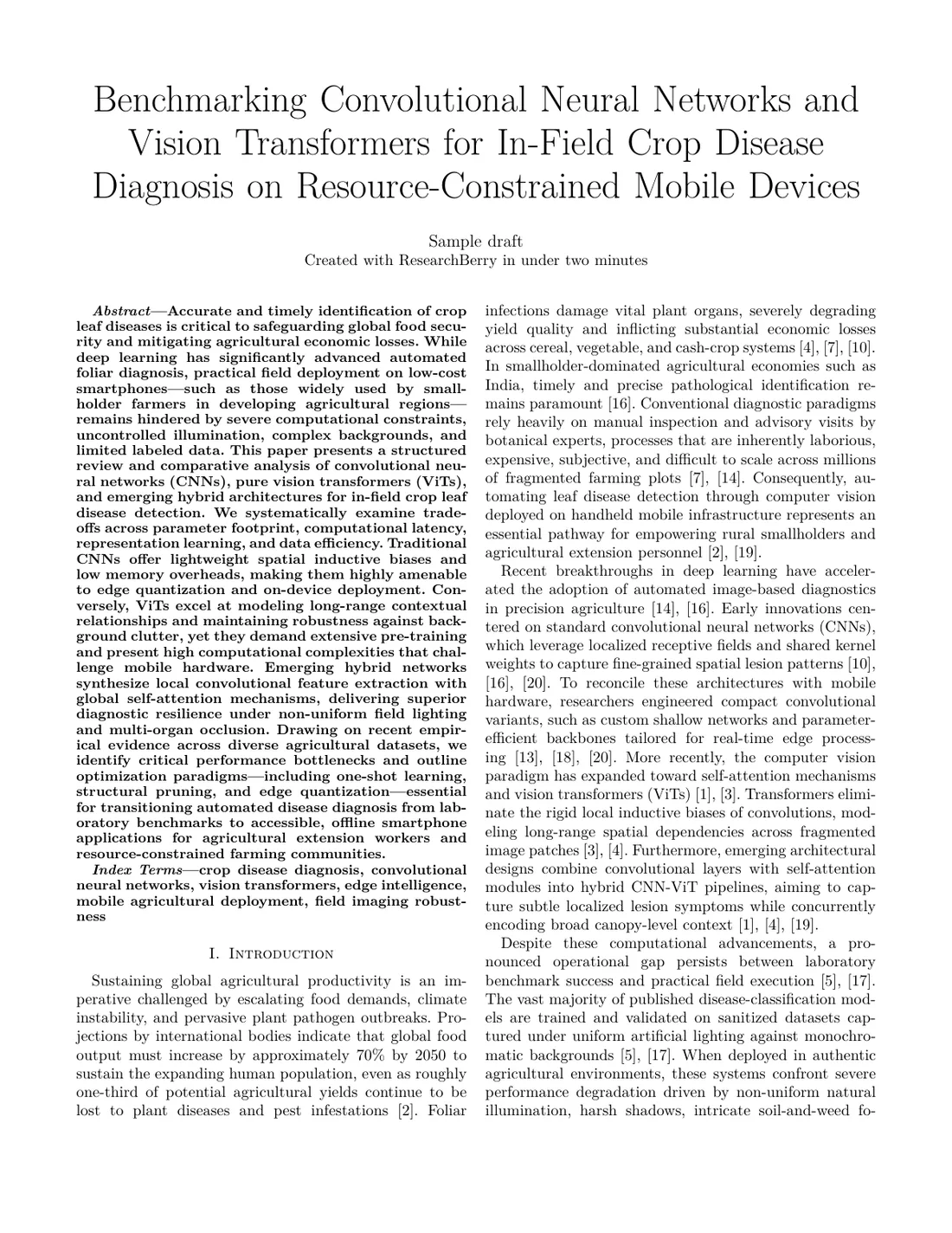
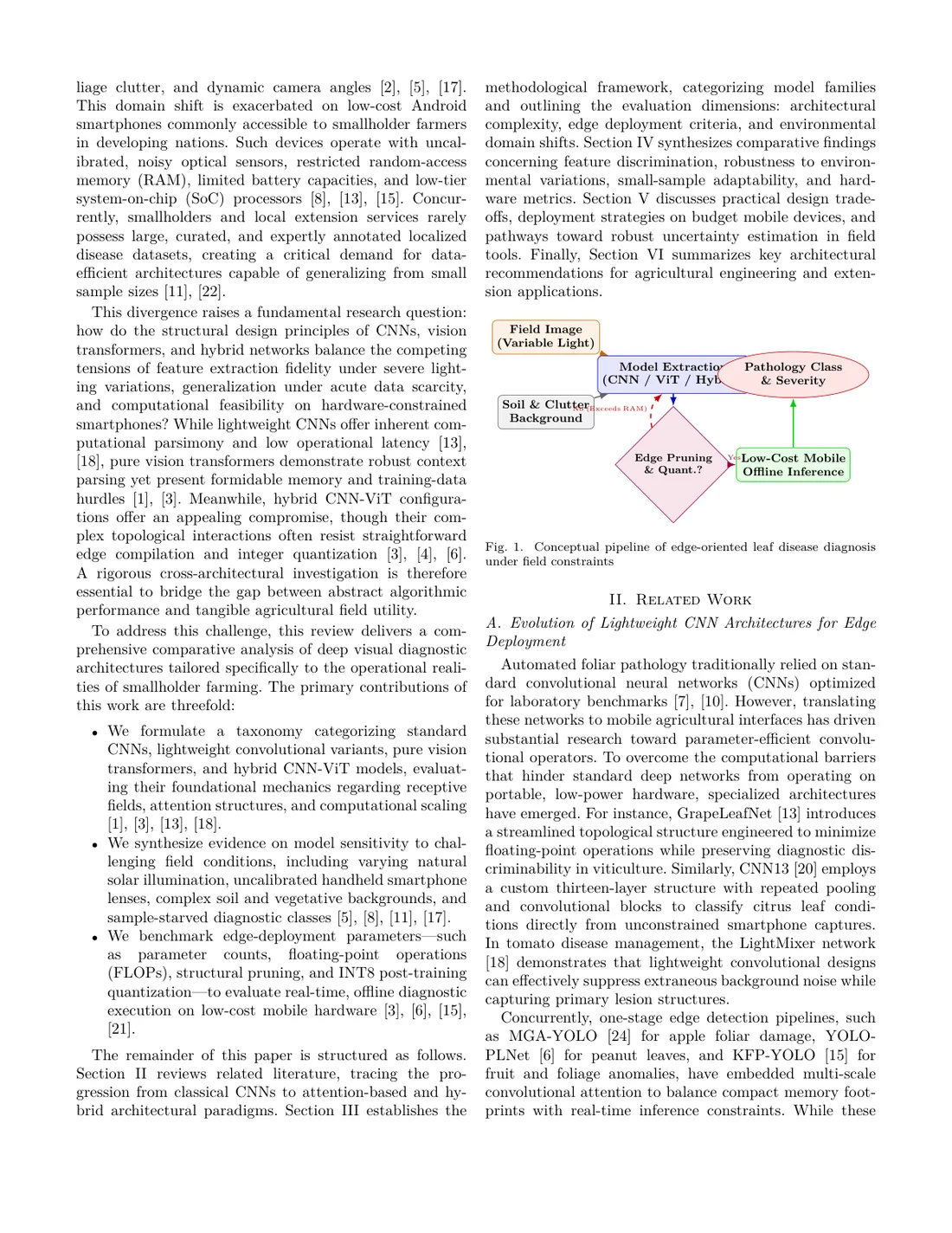
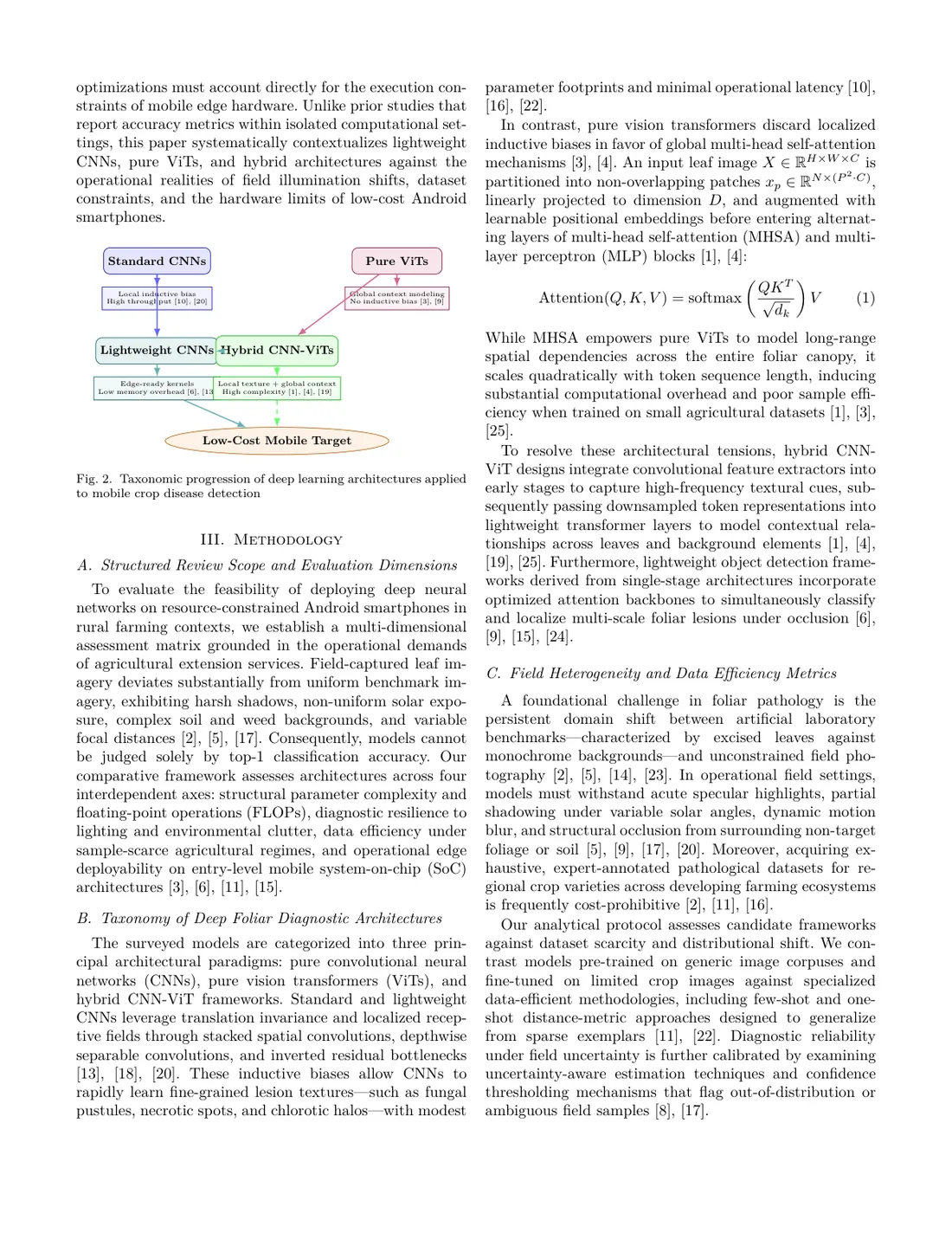
Made on 16 October 2026 with the live system. The idea above was the only input; the 25 sources were picked automatically from search results.
From idea to paper in four steps.
You see what you are buying before you buy it.
Write your idea
A few sentences are enough. If you already have notes, results or a reading list, paste them in and the paper is built around them.
Choose the real papers to cite
We search Crossref, OpenAlex and Europe PMC and show about 25 matches with their abstracts. Untick any you do not want.
See the start of your paper
We write the start of your paper: your title, the opening paragraph, and a real page of your format. Nothing is charged yet.
Create the paper, then change anything
About two minutes later you have the typeset paper. Ask the AI editor for changes in plain words, then download PDF, Word or LaTeX.
What is in every full paper.
- Ten formats
- IEEE, Springer LNCS, Elsevier, APA 7, Harvard, AMA, Vancouver, MLA 9, Chicago and Turabian. Title page, headings, fonts, margins, in-text citations and the reference list all follow the style, in the PDF and in the Word file.
- Diagrams drawn for your topic
- Architecture, process and concept diagrams are drawn in LaTeX for your paper, not picked from a stock set.
- PDF, Word and LaTeX
- Download the typeset PDF, an editable Word file with the diagrams as images, or the LaTeX source to keep working in Overleaf.
- An AI editor, five edits per paper
- Ask for “add my survey results”, “shorten the introduction” or “add a limitations paragraph”. Only what you ask for changes, and every version is kept.
- Your own data stays in charge
- Paste your results or notes and the paper reports them. Without them, nothing is invented (see below).
- Private to your account
- Your papers are stored privately and downloads use short-lived links. Delete a paper and its files are deleted too.
It drafts. You stay the author.
We would rather tell you the limits now than have an examiner find them later.
What ResearchBerry does
- Cites only papers that exist, taken from public databases.
- Reports your data and results when you provide them.
- Without your data, the Results and Discussion analyse what the cited research reports and say what is expected, in careful words.
- Never creates fake experiments, datasets or statistics.
What stays with you
- Reading the paper and checking the claims against the sources.
- Following your university’s or journal’s rules on AI tools, and disclosing use where required.
- Running your own similarity check. We cannot promise any score.
- Matching a specific journal template. We follow the citation style, not a journal’s own layout.
Pay per paper. No subscription.
A credit creates one full paper. Credits stay in your account until you use them, and a credit is returned automatically if a paper fails.
Free preview
₹0
2 previews per account
- Your paper's title and its opening paragraph
- A real page of your chosen format
- How many real papers it will cite, with three shown
One paper
₹699
1 credit
- About 5,000 words, typeset in your style
- Real citations and drawn diagrams
- PDF, Word and LaTeX downloads
- 5 AI revisions
Five papers
₹2,499
₹500 each · save 28%
- Everything in One paper, five times
- For a thesis, a semester of projects or a research group
Online checkout is opening soon. Until then, press Request inside the app, send the email, and we reply with payment details. Credits are added as soon as payment is confirmed.
Universities, labs and training institutes: email hello@mayavis.com for group credits and invoices.
Questions, answered plainly.
Put your idea in. See your title and a real page of your paper before you pay anything.
Sign in with Google. No card needed.